
 Canada
 USA
 Japan



MOPP Holding Tape for Appliance Manufacturing

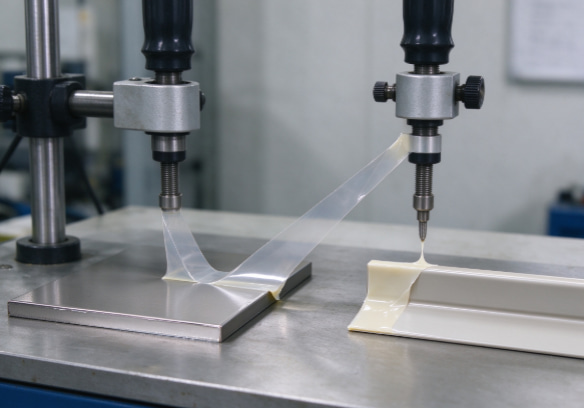
MOPP holding tape provides a film based restraint for appliance parts during factory movement and transport. Its mono oriented polypropylene backing helps limit lengthwise stretch. The adhesive must hold the component during shipment and release acceptably from the finished surface afterward.
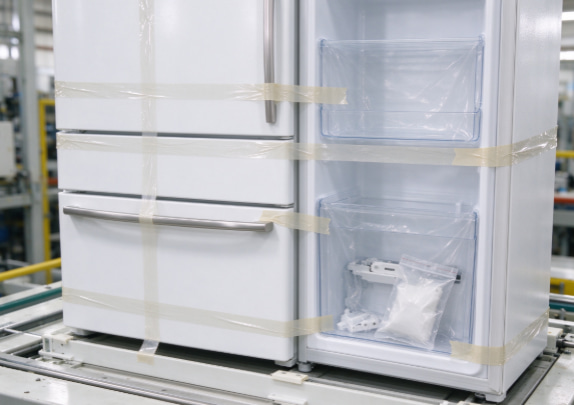
Start with the restraint location: a door edge, drawer front, plastic liner, or accessory pack. Each introduces a different contact surface and load path. Approve the tape for those locations rather than for an appliance name alone.
What MOPP Contributes to Temporary Restraint
Mono orientation changes the mechanical behavior of the polypropylene film. MOPP strapping tape constructions are commonly selected where lengthwise strength and limited stretch are useful. The exact performance depends on the film, adhesive, and finished tape design.
tesa’s MOPP strapping tape documentation combines backing behavior with handling characteristics. For appliance work, add removal from the actual finish to that comparison. A general bundling construction and a temporary finish contact construction may need different adhesive behavior.
Backing and adhesive solve different problems
The backing resists mechanical deformation. The adhesive maintains contact with the appliance or overlapping tape. A strong film can remain intact while an adhesive edge lifts.
Likewise, a highly aggressive adhesive can restrain a component but damage a weak coating during removal. The useful construction meets both holding and release requirements. Neither maximum strength nor minimum peel is the objective by itself.
PET and reinforced filament tapes may also be considered for temporary restraint. Their behavior should be compared against the same appliance requirements. A material name is a starting point, rather than a finished selection.
| Construction | Evaluation emphasis | Possible concern |
| MOPP holding tape | Film restraint and removal balance | Splitting, edge lift, surface marking |
| PET holding tape | Film handling and restraint behavior | Stiffness and finish compatibility |
| Filament tape | Reinforced restraint under package loads | Removal effort and surface contact |
| Foam blocking with external restraint | Component cushioning and movement control | Packing volume and assembly consistency |
Temporary Holding Tape for Appliances in Real Workflows
Map each location where the tape touches the appliance. Doors, trays, shelves, and accessory packs can involve different materials. One approved grade may not suit every contact point.
Holding doors and drawers during transport
Define the direction and amount of movement that must be prevented. Include latch behavior and the effects of vibration. Tape should complement the approved packing design rather than compensate for an undefined restraint system.
Consider component leverage. A long drawer front or door can concentrate force near a tape edge. Changing tape placement may improve performance more effectively than increasing adhesive aggressiveness.
Securing accessories and internal parts
Small accessory packs may contact coated metal, plastic liners, or protective films. Identify which surface actually receives the adhesive. A tape attached to protective film depends on that film’s own adhesion.
Loose components can rub against restrained parts during shipment. Include abrasion and contact marking in the inspection. A successful holding test should not conceal cosmetic damage elsewhere.
Handling during factory movement
Temporary restraint may be applied before several internal handling steps. Record the elapsed time before packing and the conditions during storage. Tape behavior after immediate application can differ from behavior after a prolonged dwell.
If a process includes warming, cleaning, or exposure to chemicals, evaluate that stage specifically. Do not treat a service temperature range as proof of compatibility with every manufacturing process. Exposure duration and load remain relevant.
Evaluate Residue and Finish Changes After Transport
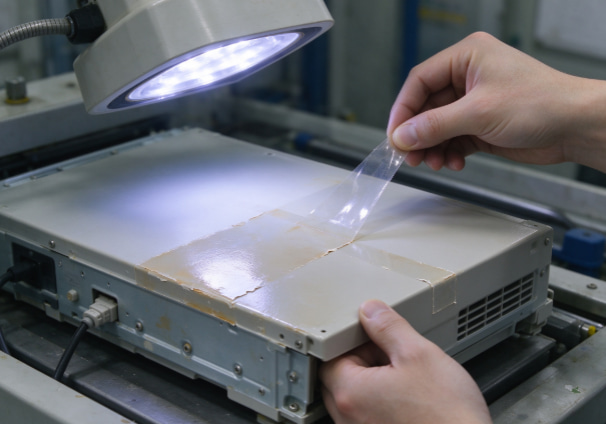
Removal quality includes adhesive residue, visible staining, coating lift, gloss change, and backing breakage. A clean looking surface immediately after removal may still show a mark under controlled lighting. Define what the customer will inspect.
Start with the actual production coating and cure condition. Paint formulation, surface texture, and aging can affect the result. A substitute laboratory panel may miss these differences.
Include a planned exposure matrix:
- Shortest and longest expected dwell before removal.
- Warehouse and transport temperature conditions.
- Humidity or condensation where relevant.
- Contact with packaging materials or protective films.
- Removal temperature and the intended user technique.
- Inspection immediately after removal and after a defined interval.
Use the same removal method when comparing candidates. Record direction, speed, and whether the backing remains intact. Then check whether the required technique is realistic for the unpacking user.
Establish the removal mechanism with the selected grade. A pull tab can make the end accessible, but it does not turn a conventional film tape into a stretch release construction. The unpacking instruction should match the tape design.
Distinguish adhesive residue from damage beneath the adhesive. Coating fragments on the tape suggest a surface integrity problem. Residue on an intact coating suggests a different failure mode.
Define a Repeatable Holding and Unpacking Process
Set tape length, position, overlap, and application pressure in the work instruction. Operators should not improvise extra tension to compensate for inconsistent placement. Photograph the approved arrangement for each appliance variant.
Test the complete packaged unit under its transport specification. Inspect component movement, tape condition, and package damage. Repeat removal checks after the same conditioning sequence.
When a failure occurs, examine its location before changing material. Edge lift may indicate poor contact or peel loading. Film splitting may relate to damage during cutting or an unsuitable restraint geometry.
Include practical line observations. Unwind effort, cutting consistency, visible color, and removal access affect usability. A construction that works only with unusually careful handling may be difficult to sustain at production speed.
A restraint crossing painted metal and plastic trim can release unevenly. Test a continuous strip across that transition, including the seam and any change in height. Separate flat coupons miss the stress created when one section releases first.
Check how the user finds and grips the tape end. A practical access feature can reduce scraping or repeated picking at the finish. Its design must remain compatible with the selected tape and packing arrangement.
Review the restraint when a hinge, drawer gap, or surface radius changes. Those details alter leverage and the contact available near an edge. Keep the approved tape arrangement with the packing drawing for that appliance variant.
For a related film option, F6’sPET holding tape articleprovides comparison context. Evaluate alternatives using the same restraint and removal criteria.
F6’s holding tape range includes two MOPP constructions with the same listed total thickness:
| Candidate | Published backing and thickness | Published adhesive description |
| FM701 MOPP holding tape | MOPP, 0.11 mm | Solvent based pressure sensitive adhesive |
| FM702 MOPP holding tape | MOPP, 0.11 mm | Natural rubber |
The shared thickness does not establish identical removal behavior. Compare each grade on the approved coating after the planned transport dwell. Record staining, gloss change, adhesive transfer, and film breakage separately from component movement.
FAQ
Can one MOPP grade be used across an appliance range?
Possibly, after evaluating every relevant surface and restraint location. Different coatings, plastics, and protective films can require separate approval.
Does low peel adhesion guarantee clean removal?
No. Residue and surface damage also depend on adhesive cohesion, coating integrity, dwell, temperature, and removal conditions.
Should the tape be applied under heavy tension?
Use only the tension established by the validated packing process. Excess tension can stress tape edges, deform packaging, or damage finished components.