
 Canada
 USA
 Japan



Filament Tape for Bundling and Reinforced Packaging

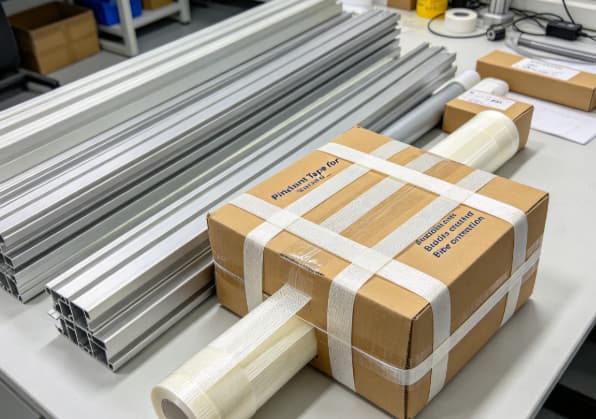
Filament tape for bundling combines an adhesive layer with reinforcing fibers that help restrain grouped items. Choose the reinforcement direction for the package geometry, then assess adhesive anchorage and overlap. The finished bundle must tolerate the intended storage and handling sequence.
The backing can remain unbroken while the bundle loosens. Corrugated edges may compress, profiles may slide, or an adhesive overlap may creep. Finding that weak point is more useful than choosing the highest tensile number.
How Reinforcement Direction Changes Bundle Behavior
Fiberglass filament tape commonly uses longitudinal or crossed reinforcement. Longitudinal fibers mainly support loads along the tape length. Cross reinforcement adds fibers across the web, influencing resistance to splitting and multidirectional damage.
The arrangement matters when a package encounters corners, punctures, or uneven handling. A narrow cut can become a starting point for a split. Cross reinforcement may help in some geometries, but the actual construction still needs evaluation.
tesa’s cross filament tape documentation describes bidirectional glass reinforcement for bundling and transport restraint. It illustrates a construction intended to resist splitting across the web as well as lengthwise forces. Compare those directions against the likely damage at the package corners.
| Feature | Longitudinal reinforcement | Cross reinforcement |
| Main fiber direction | Along the tape length | Along and across the web |
| Common evaluation focus | Lengthwise restraint | Restraint and splitting behavior |
| Corner sensitivity | Assess cuts and edge damage | Assess punctures and fiber damage |
| Selection evidence | Package and tensile tests | Package and directional tests |
Reinforced filament tape is different from fiberglass double sided bonding tape. A bundling tape normally restrains the outside of a package using one adhesive face. A double coated reinforcement joins two surfaces within an assembly.
Elongation and tension retention
Low elongation can help limit initial movement, but it does not describe the entire restraint system. Adhesive slip, package compression, or substrate deformation can still relax the bundle. Inspect the complete package after conditioning.
Avoid stretching the tape beyond a validated application condition. Extra tension can crush carton edges or mark a finished component. Application consistency matters as much as the selected construction.
Bundling Profiles, Tubes, and Heavy Cartons
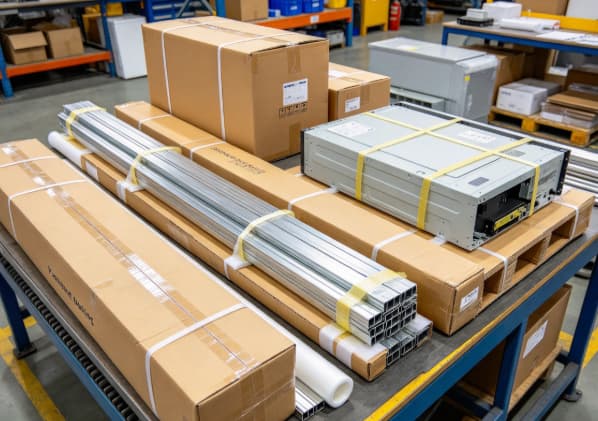
The correct tape arrangement depends on what moves inside the bundle. Smooth profiles may slide relative to each other. Corrugated cartons can compress or change shape after stacking.
Metal and plastic profiles
Long profiles create leverage during handling. Place restraint where it controls movement without exposing finished surfaces to unacceptable marking. Protective sleeves or separators may be necessary when contact surfaces are delicate.
Oils, dust, and release agents can reduce adhesion. Test the actual production finish and cleaning condition. Bare metal laboratory results may not represent oiled or coated stock.
Corrugated packaging
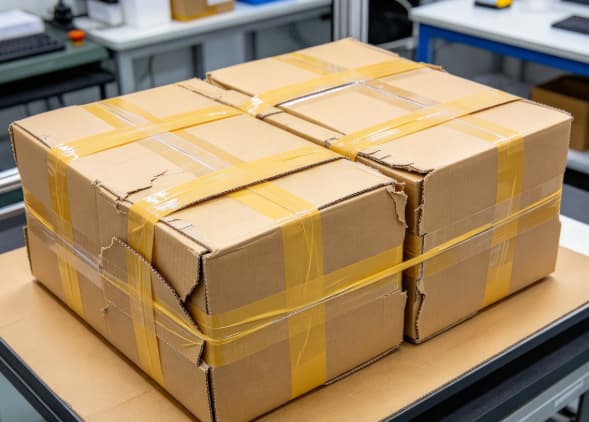
Carton reinforcement depends on the linerboard surface and the package design. Recycled content, printing, coatings, and dust can alter adhesive contact. High adhesion to steel does not establish holding performance on every carton.
Check whether failure occurs through linerboard tearing or adhesive release. Both may open a package, but they call for different changes. Increasing tape strength may simply move failure into the carton.
Appliance and component shipments
Components with moving parts may require localized restraint during transport. Verify that the tape remains accessible for removal. A strong wrap placed across a visible finish can create an avoidable unpacking problem.
Treat bundling tape as one part of the specified package restraint. Lifting equipment and freight tie downs have separate load and attachment requirements. Establish the role of the tape within the approved packing design.
Reinforced Filament Tape: Read the Test Conditions
Tensile strength describes the force associated with stretching or breaking a tape specimen under defined conditions. Reported units and specimen widths must match before comparison. Strength per width is not automatically a package load rating.
ASTM D3759/D3759M addresses tensile strength and elongation of pressure sensitive tapes, including reinforced constructions. Use a mutually agreed edition and procedure when comparing results. The public description does not replace the complete test method.
Adhesion and holding behavior need separate attention. A backing may remain intact while an overlap slowly slips. Temperature and storage duration can influence this failure mode.
Document these conditions during evaluation:
- Tape width and reinforcement orientation.
- Bundle dimensions and component weight.
- Number, position, and overlap of restraint bands.
- Application tension and surface pressure.
- Substrate finish and cleanliness.
- Temperature, humidity, and storage duration.
- Movement, splitting, edge damage, and residue after testing.
For numerical comparisons, distinguish machine direction from cross direction results. Also distinguish breaking strength from force at a stated extension. They answer different questions about behavior.
Adhesive chemistry affects initial grab and later performance, but category names are insufficient. Two synthetic rubber systems can behave differently. Compare the exact grade under the intended conditions.
Follow the Load Through the Wrap and Overlap
Begin with the actual bundle and application method. Reproduce the intended tape position, overlap, and operator technique. Use the packaging specification to select conditioning and transport simulation requirements.
Inspect immediately after application and again after storage. A package that looks tight initially may relax later. Include handling events that can damage edges or expose the tape to friction.
For long profile bundles, inspect for sliding and corner damage; for cartons, check for seam opening and linerboard tearing; for finished components, record surface marking and the effort required for removal.
Where several constructions appear similar, compare total packing performance. Manual cutting effort, unwind behavior, and rejected packages can matter more than roll price. Keep these observations alongside laboratory measurements.
A small nick at a stressed corner can start a split. Include normal cutting and handling in the package trial, especially where the wrap passes over a sharp profile. Edge protection may change the result more than a stronger adhesive.
Inspect the final overlap after the bundle settles. If a profile slides toward the overlap, it may introduce peeling that was absent at application. Record both the initial arrangement and the restraint position after conditioning.
Retain an unused tape sample from the trial. If a later package fails, this reference helps separate a construction difference from changed packaging or handling conditions. Keep the sample identity with the package trial record.
F6’s holding tape category separates reinforcement based tapes from film holding tapes. For a mesh construction, F089 fiberglass filament tape is listed with synthetic rubber adhesive and 0.14 mm total thickness.
Use the package trial to establish wrap position, overlap, and surface compatibility. A mesh backing may remain intact while a coated carton surface tears beneath it. Inspect the carton or component surface alongside the tape when comparing results.
FAQ
Is cross filament tape always stronger than striped filament tape?
No. Directional properties depend on fiber arrangement, quantity, backing, and width. Compare the required direction and the complete package result.
Can it replace plastic strapping?
Sometimes, where a validated packaging design allows it. Tape adhesion, overlap, package compression, and handling requirements must support the substitution.
Why does a bundle loosen when the tape has not broken?
The package may compress, components may slide, or the adhesive overlap may creep. Examine these mechanisms before selecting a stronger backing.