
 Canada
 USA
USA Japan
Japan


Double Sided Tape Manufacturer for Industrial Assembly

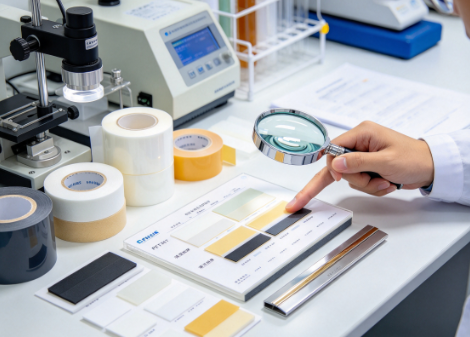
For industrial assembly, double sided tape is often selected because it can bond parts without visible fasteners, liquid glue curing time or mechanical drilling. But the result depends heavily on the tape structure and the supplier’s ability to match adhesive, carrier, thickness and liner to the production process. This is why choosing a reliable double sided tape manufacturer matters.
F6Tape provides industrial double sided tape for bonding, mounting and assembly applications. Buyers who are still comparing broader tape options can also review the full F6Tape products.
Where double sided tape is commonly used
Industrial double sided tape may be used for nameplates, plastic parts, metal trims, foam bonding, membrane switches, appliance panels, display components, packaging inserts and light assembly tasks. In many cases, the buyer is not simply looking for the strongest tape, but for the tape that fits the surface, production speed and final use condition.
For example, a thin double sided tape may be suitable for flat plastic films, while foam tape may be better when the surface is slightly uneven or when gap filling is needed.
Key points when selecting a manufacturer
A double sided tape manufacturer should help confirm the following details:
- Substrate material on both sides
- Required thickness and carrier type
- Initial tack and final bonding strength
- Temperature and humidity exposure
- Die-cut or roll supply requirement
- Liner release performance during assembly
For electronics or precision assembly, cleaning and pressure are especially important. 3M’s electronics bonding technical resources note the importance of clean substrates and proper pressure for bonding contact. This is useful for buyers who need consistent assembly performance rather than a one-time sample pass.
Manufacturer vs ordinary supplier
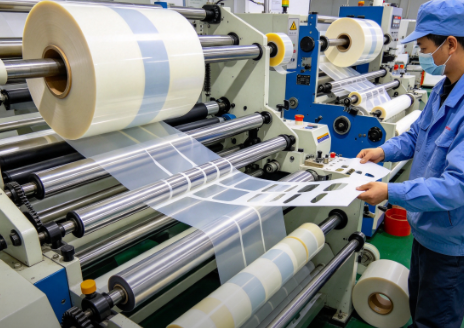
A distributor may help with standard products, but a manufacturer is often more useful when the buyer needs custom width, private label, stable repeat orders or converting support. For industrial assembly, small details such as liner release, edge quality and roll tension can affect production speed.
F6Tape can support discussion around product structure, size, packaging and application requirements. Buyers can start with the industrial double sided tape category and then request a recommendation based on actual assembly conditions.
Practical selection checklist
Before confirming an order, test the tape on real parts. Check whether the tape wets out properly, whether the liner can be removed smoothly, whether parts shift after bonding, and whether the bond remains stable after storage or transport.
If the project involves foam mounting, it may be more suitable to compare with foam double sided tape instead of using a thin double sided tape.
Assembly process questions to confirm
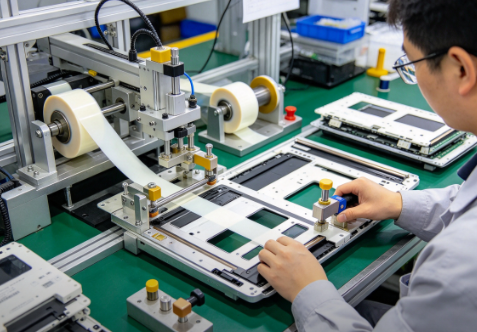
Industrial assembly buyers should describe how the tape is applied in production. A hand-applied tape used for small batches may need different unwind and liner behavior from a tape applied through fixtures or semi-automatic equipment. This is one area where a double sided tape manufacturer can add value: the tape must fit the assembly process, not only the final bond.
Useful questions include whether the tape needs immediate handling strength, whether parts can be repositioned, whether the bond line must stay invisible, and whether the assembly will face vibration, heat or storage pressure. These points are especially important for appliance panels, plastic trims, nameplates and display components.
Matching tape structure to surface conditions
The carrier and adhesive structure should match the two surfaces being joined. Tissue double sided tape can work for many general assembly tasks, PET double sided tape may provide better dimensional stability, and mesh fiberglass double sided tape can help when reinforcement is needed. Buyers can review these related options under industrial double sided tape.
If the surface is rough or slightly uneven, moving directly to a stronger adhesive may not solve the issue. A foam carrier may improve contact area, while a thinner tape may be better for precise parts with tight gaps. The selection should be based on the surface pair and assembly tolerance.
FAQ
What makes industrial double sided tape different from office tape?
Industrial double sided tape is selected for material structure, bonding strength, thickness, liner behavior and production use. Office tape is not designed for controlled assembly performance.
Can double sided tape replace glue?
In some applications, yes. It can reduce curing time and simplify assembly. However, suitability depends on surface material, load, temperature and final use condition.
Should buyers choose thin tape or foam tape?
Thin tape is suitable for flat surfaces and low profile bonding. Foam tape is usually better for gap filling, cushioning and slightly uneven surfaces.