
 Canada
 USA
USA Japan
Japan


Adhesive Tape Factory: Slitting, Coating & Custom Roll Services


An industrial adhesive tape factory does more than simply package pre-made materials. It integrates complex chemical formulation, web coating, precision slitting, and custom converting to produce industrial bonding solutions. For OEM manufacturers and procurement managers, understanding these factory-level capabilities is essential for optimizing supply chains.
Selecting the right manufacturing partner requires evaluating their core production processes. Whether an application demands high-temperature resistance, exact dimensional tolerances, or specialized liner modifications, the capabilities of the facility directly dictate the final performance.
The Role of an Adhesive Tape Coating Factory
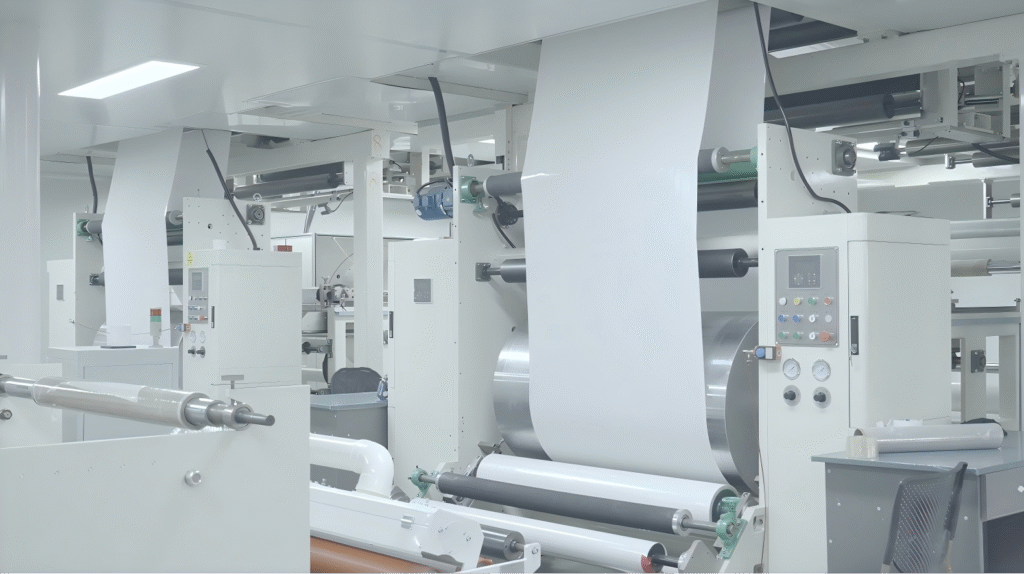
The foundation of any high-performance bonding solution begins in the coating phase. An adhesive tape coating factory applies formulated liquid adhesives—such as acrylics, natural rubbers, or silicones—onto various substrates like PET, PVC, tissue, or metal foils.
The Web Coating Process
- Web Handling: Master rolls of raw substrate are fed into the coating line under controlled tension.
- Adhesive Application: Adhesive is applied using precision metering systems, such as slot die or Meyer rod, ensuring a consistent coat weight.
- Drying and Curing: The coated web passes through multi-zone thermal ovens to remove solvents or is cured via UV light.
- Lamination: A release liner is laminated to the web to protect the exposed adhesive layer.
- Master Roll Winding: The finished web is wound into large jumbo rolls, often exceeding 1,000 meters in length.
Coat weight consistency is critical during this stage. Uneven adhesive distribution leads to variable peel adhesion and shear strength, which can cause unpredictable failure in automated assembly applications.
Precision Tape Slitting Service
Industrial applications rarely utilize tape in master roll formats. A professional tape slitting service transforms wide jumbo rolls into the specific widths required by the end-user. The choice of slitting technology dictates the edge quality and dimensional tolerance of the finished roll.
| Slitting Method | Technical Mechanism | Best Suited For | Typical Tolerance |
|---|---|---|---|
| Lathe Slitting (Log Slitting) | A single circular blade cuts through a stationary or spinning roll. | Foam tapes,thick double-sided tapes, short runs. | ± 0.5 mm to ± 1.0 mm |
| Rewind Slitting | The master roll is unwound, passed through multiple rotary blades, and rewound onto separate cores. | Thin films, electrical tapes, high-volume production. | ± 0.1 mm to ± 0.2 mm |
| Crush Cut Slitting | A blunt blade presses the web against a hardened steel anvil roll. | Non-wovens, cloth tapes, heavy-duty duct tapes. | ± 0.5 mm |
For automated dispensing systems, edge quality is paramount. Adhesive oozing or frayed edges can jam application machinery. Modern factories control web tension and blade geometry to prevent adhesive displacement during the slitting process.
Adhesive Tape Converting and Customization
Beyond basic width reductions, adhesive tape converting adapts the material to specific manufacturing workflows. Converting transforms continuous rolls into specialized formats designed for rapid assembly and reduced material waste.
Custom Tape Rolls
Standard tape lengths are often inefficient for high-volume manufacturing. OEMs frequently specify custom tape rolls with extended lengths to minimize changeover downtime on assembly lines. This is particularly common with thin double-sided PET tapes and transfer tapes used in electronics manufacturing.
Spooling (Traverse Winding)
Instead of winding tape directly on top of itself in a planetary roll, spooling winds the tape laterally across a wider core. This allows thousands of meters of narrow-width tape to be housed on a single roll. Spooling drastically reduces the frequency of roll changes in continuous production environments.
Die-Cutting
For component assembly, factories utilize rotary or flatbed die-cutting to create custom shapes. Die-cut parts eliminate manual cutting on the assembly line, ensuring precise placement. These parts are typically supplied on a continuous liner with the surrounding matrix removed for easy picking.
Quality Control in Tape Manufacturing
Consistent production requires rigorous in-house testing. A reliable adhesive tape factory validates batches against standard industry test methods before shipping.
Key quality control metrics include:
- Peel Adhesion (180° or 90°): Measures the force required to remove the tape from a standard stainless steel panel.
- Static Shear: Evaluates the tape’s internal cohesive strength and ability to support a static load over time.
- Initial Tack: Tests how quickly the adhesive forms a bond upon light contact with a substrate.
- Thickness Verification: Ensures the substrate, adhesive, and liner meet specified dimensional tolerances.
Partnering with F6 Tape
Working directly with an integrated manufacturer provides distinct commercial and technical advantages. As an industrial adhesive tape supplier, F6 Tape manages production processes from material selection to final converting.
By controlling coating, slitting, and converting internally, F6 Tape can adapt formulations, modify release liners, and engineer custom tape rolls that match operational demands. This integration ensures higher batch-to-batch consistency and provides procurement teams with a reliable supply chain.
FAQ
What is the difference between log slitting and rewind slitting?
Log slitting cuts through an entire wound roll of tape with a single blade, making it ideal for thicker materials like foam tapes and quicker changeovers. Rewind slitting unwinds the master roll, slices the web with multiple blades, and rewinds it, offering tighter dimensional tolerances for thin films and high-volume runs.
Can an adhesive tape factory customize tape length and width?
Yes. Through custom converting and slitting services, factories can produce custom tape rolls in specific widths and extended lengths to match the requirements of automated assembly equipment.
What is spooling in adhesive tape converting?
Spooling, or traverse winding, wraps narrow tape laterally across a wide core. This allows a single roll to hold thousands of meters of tape, significantly reducing roll changeover time in continuous manufacturing processes.
How do manufacturers ensure adhesive consistency?
Factories use precision coating heads (like slot die or Meyer rod) to control coat weight. Batches are then tested for peel adhesion, static shear, and initial tack to ensure they meet specified performance standards.