
 Canada
 USA
USA Japan
Japan


Best Adhesive Tape for Flexible Display Assembly: A Technical Guide

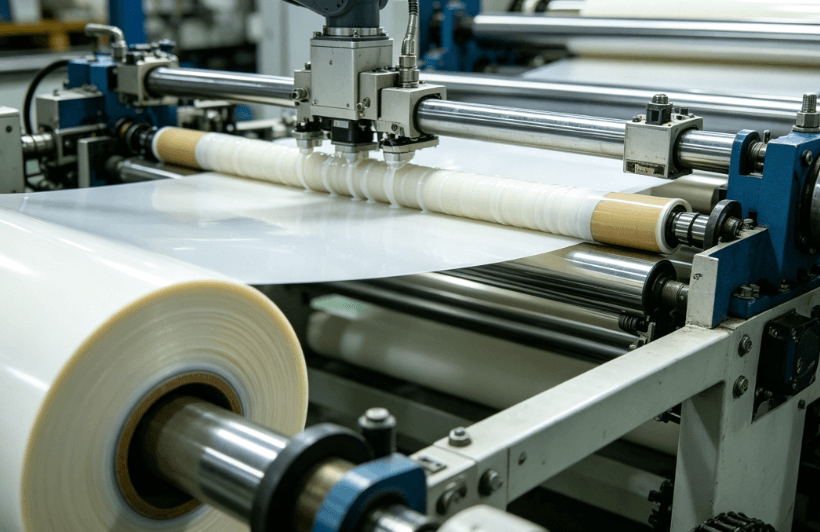
The engineering of flexible displays—ranging from foldable smartphones to curved automotive dashboards—represents a fundamental shift in electronics manufacturing. Unlike traditional rigid screens, flexible OLED and AMOLED modules are subject to repetitive mechanical stress and internal tension. Consequently, the choice of tape for display assembly has evolved from simple structural bonding to active stress management.
For manufacturing engineers and OEM project managers, the challenge is finding an adhesive that provides high peel strength while remaining viscoelastic enough to absorb energy during thousands of fold cycles. Using the wrong adhesive chemistry can lead to delamination, bubbling, or, in severe cases, the chemical corrosion of the sensitive Indium Tin Oxide (ITO) layers.
Critical Material Specifications for Flexible Displays
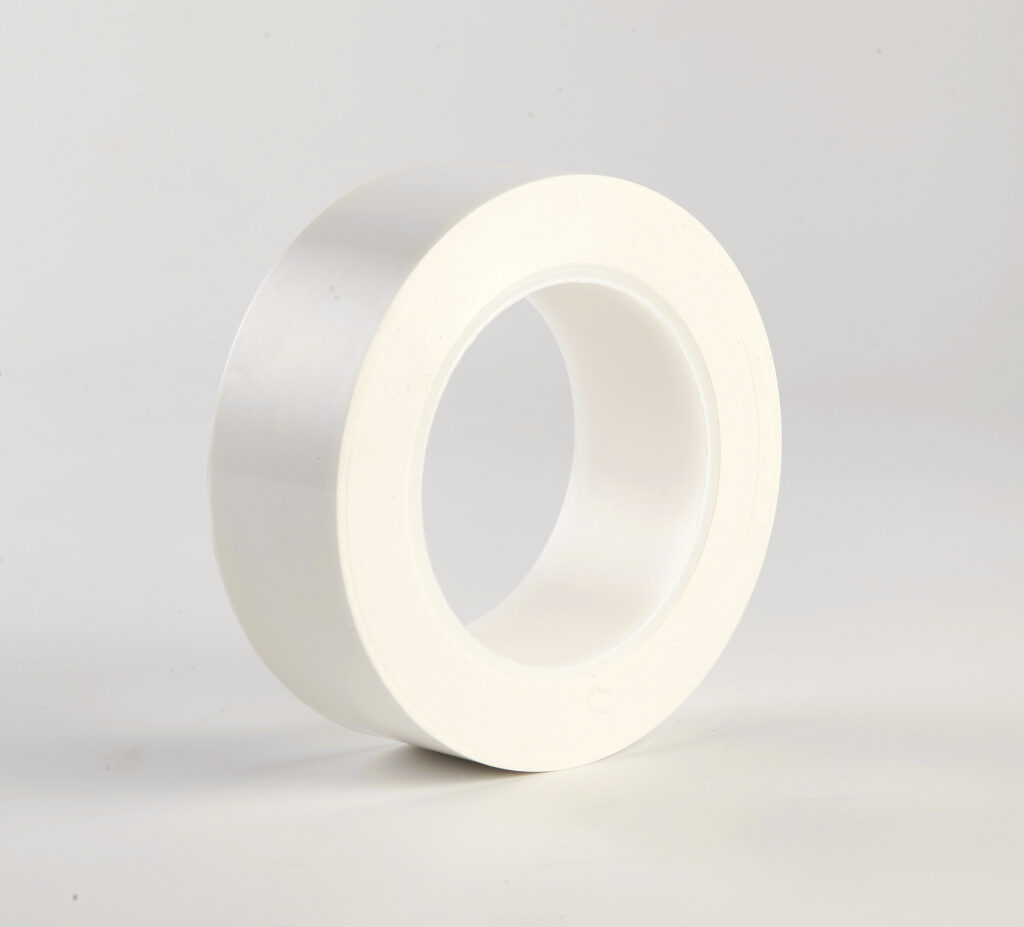
When selecting a high-performance tape for display assembly, the evaluation must go beyond basic adhesion metrics. High-tech flexible laminates require specific rheological properties to ensure long-term reliability.
1. Viscoelasticity and Stress Relaxation
The adhesive must behave like a liquid under stress to flow and redistribute tension, yet return to a solid state to maintain structural integrity. This is often referred to as the “creep” property. Tapes with superior stress relaxation prevent the “lifting” of layers at the curvature radius of a fold.
2. Optical Clarity (OCA Properties)
If the tape is used within the active viewing area, it must be an Optically Clear Adhesive (OCA). These tapes must provide over 99% light transmission and a haze level below 1%. Crucially, they must remain non-yellowing even after prolonged exposure to UV light and high operating temperatures.
3. Acid-Free Chemistries
Many standard acrylic adhesives contain trace amounts of acid from the polymerization process. In display assembly, these acids can react with the transparent conductive layers (ITO). Manufacturers must specify “acid-free” or “low-corrosion” grades to prevent pixel failure over the device’s lifespan.
Comparative Evaluation of Display Assembly Tapes
Different stages of the display stack require different tape architectures. The following table outlines the trade-offs between common industrial solutions found in specialized tape product catalogs.
| Tape Technology | Primary Application | Key Advantage | Manufacturing Limitation |
| Acrylic Transfer Tape | Backplate Laminating | High thermal resistance | Can be difficult to die-cut |
| Viscoelastic Foam Tape | Frame Bonding | Excellent impact absorption | Thicker profile (>0.15mm) |
| PET-Carrier Double Sided | Component Fixing | Dimensional stability | Limited flexibility/stretch |
| Optically Clear (OCA) | Touch Sensor Bonding | Invisible bond line | Requires Class 100 cleanroom |
Manufacturing Constraints and Outgassing
From an industrial manufacturing perspective, “outgassing” is a silent killer of display yield. When adhesives are exposed to heat during the curing of other components, they can release volatile organic compounds (VOCs). If these gases are trapped within the display stack, they create microscopic bubbles that expand over time, leading to costly field failures.
High-end display assembly requires tapes that have undergone vacuum baking or specialized degassing during the coating process. Furthermore, the liner selection—typically a high-grade silicone-coated PET—must ensure a smooth, particulate-free surface to prevent “fisheyes” in the adhesive layer.
Integration with Automated Assembly Lines
Efficiency in high-volume production depends on the tape’s ability to be die-cut and applied via robotic pick-and-place systems.
- Release Force Consistency: The force required to remove the liner must be uniform to prevent machine jamming.
- Anti-Lifting Properties: During high-speed lamination, the tape must provide immediate “green strength” to hold components in place before full cross-linking occurs.
- Thickness Tolerance: For modern ultra-thin devices, a thickness tolerance of ±3 microns is often required to maintain the design’s Z-axis specifications.
When sourcing from an industrial provider like F6Tape, procurement managers should audit the supplier’s cleanroom capabilities and their ability to provide custom slit widths. Precise slitting reduces edge-oozing, a common problem where adhesive migrates past the component edge and interferes with the display’s bevel or bezel.
Summary of Performance Logic
The “best” tape is ultimately determined by the display’s minimum bend radius and the environmental conditions it will face. For automotive flexible displays, heat and humidity resistance are the priorities. For consumer foldables, the mechanical fatigue resistance and ultra-thin profile take precedence. By prioritizing viscoelasticity and chemical neutrality, engineers can ensure that the adhesive becomes a structural asset rather than a point of failure.
FAQ: Technical Questions on Display Assembly
Why do display tapes need to be acid-free?
Traditional acrylics can release acidic byproducts that corrode Indium Tin Oxide (ITO) sensors. Acid-free tapes use specialized monomers to ensure the electrical conductivity of the touch panel remains stable over years of use.
What is the difference between OCA and standard double-sided tape?
OCA (Optically Clear Adhesive) is manufactured in a highly controlled cleanroom to ensure zero particulate contamination and is engineered specifically for light transmission and refractive index matching. Standard tapes are designed for structural strength and do not meet the haze or clarity requirements for screen viewing.
How does “stress relaxation” prevent screen failure?
When a display is folded, the layers are compressed and stretched. A tape with high stress relaxation “flows” internally to relieve this tension, preventing the layers from pulling apart (delaminating) over thousands of cycles.
Can display assembly tape be reworked?
Some specialized display tapes are designed with “controlled adhesion,” allowing them to be peeled off cleanly during the first few minutes of assembly if a misalignment occurs. However, once fully cured, most structural display tapes are permanent and require specialized solvents or heat for removal.
Reference Sources
- ASTM D3330: Standard Test Method for Peel Adhesion of Pressure-Sensitive Tape.
- ISO 14644-1: Cleanrooms and associated controlled environments (Critical for OCA manufacturing).
- SID (Society for Information Display): Technical papers on flexible OLED encapsulation and laminating materials.
- PSTC (Pressure Sensitive Tape Council): Industry whitepapers on viscoelasticity in electronic assembly.