
 Canada
 USA
USA Japan
Japan

Custom Adhesive Tape Converting: A Guide to Precision Bonding

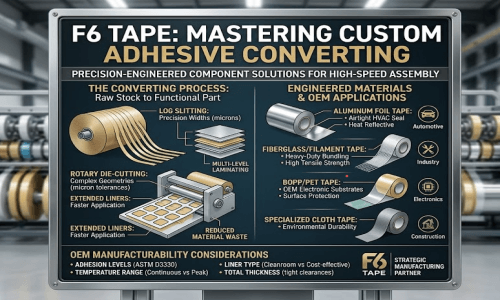
In the world of industrial manufacturing, a roll of tape is rarely just a roll of tape. It is a precision-engineered component designed to meet exact mechanical and environmental specifications. For engineers and procurement managers, understanding custom adhesive tape converting is the difference between a high-speed assembly line and a costly production bottleneck. Converting transforms raw adhesive materials into functional parts that fit specific geometries and performance requirements.
At its core, converting involves taking jumbo rolls of adhesive material and modifying them through various mechanical processes. These processes include slitting, die-cutting, laminating, and spooling. The goal is to create a product that is ready for immediate integration into an end-user’s workflow. By utilizing these services, manufacturers can reduce material waste, improve application speed, and ensure consistency across millions of units.
How Does Custom Adhesive Tape Converting Improve Production?
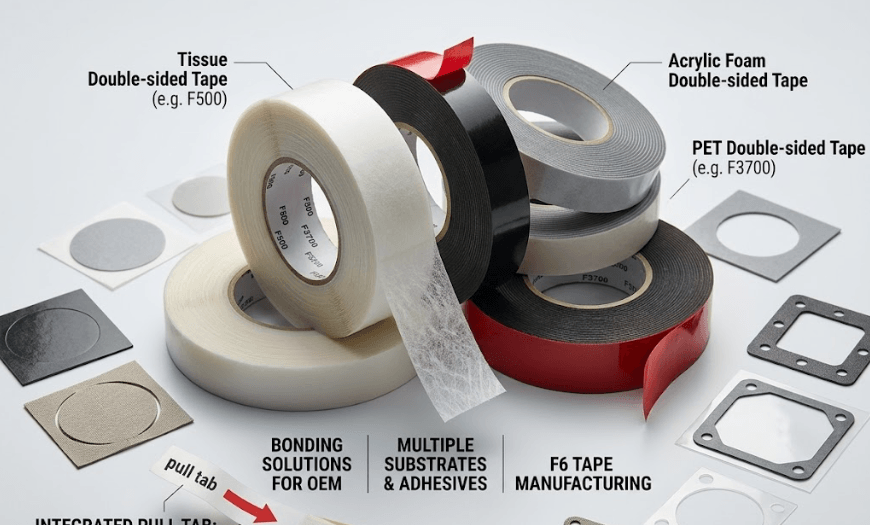
The primary advantage of professional converting is the ability to tailor every physical attribute of the adhesive. Standard off-the-shelf tapes often fail in specialized environments because they lack the necessary carrier strength or adhesive chemistry. Through converting, we can combine different substrates—such as aluminum foil, PET films, or fiberglass—with specific adhesives to solve complex bonding challenges.
Precision is the hallmark of high-quality converting. Whether you are dealing with high-temperature masking in electronics or structural bonding in automotive frames, the tolerances required are often measured in microns. A converted part must not only stick effectively but must also be easy for workers or robotic arms to apply. This often involves adding extended liners or “pull tabs” to die-cut parts to speed up the assembly process.
Core Converting Processes and Their Applications
Choosing the right converting method depends on the material type, the desired shape, and the total production volume. Each process offers distinct technical advantages:
- Slitting: This is the process of cutting a large master roll into narrower widths. At F6 Tape, we utilize log slitting and lathe slitting to provide precise widths for our aluminum foil and filament tapes.
- Die-Cutting: This creates specific shapes or “kiss-cut” parts on a liner. Rotary die-cutting is preferred for high-volume jobs, while flatbed die-cutting is ideal for thicker materials or lower volumes.
- Laminating: We often bond multiple layers together, such as adding a specialized release liner to a high-tack adhesive or combining foam with a PET carrier for vibration damping.
- Spooling and Traversing: For continuous manufacturing lines, we can wind thousands of yards of narrow tape onto a single spool, significantly reducing the downtime required for roll changes.
| Converting Process | Best Use Case | Key Technical Advantage |
| Rotary Die-Cutting | High-volume electronics/medical | Extreme speed and complex geometries |
| Lathe Slitting | Custom width rolls | High precision with minimal setup time |
| Multi-layer Laminating | Specialized industrial barriers | Combines properties of different materials |
| Flatbed Die-Cutting | Thick gaskets or small runs | Low tooling costs and deep cuts |
Material Selection for Converted Adhesive Solutions
The success of a converted part starts with the substrate. As a specialized manufacturer, our products at F6 Tape are engineered to serve as the foundation for these converting processes. The material choice dictates the thermal resistance, tensile strength, and environmental durability of the final component.
For example, our aluminum foil tapes are frequently converted for the HVAC and construction industries because they provide an airtight seal and reflect heat. In contrast, our fiberglass and filament tapes are chosen for heavy-duty bundling where high tensile strength and tear resistance are non-negotiable. When selecting a material for conversion, engineers must consider the surface energy of the substrate it will bond to, as well as exposure to UV, moisture, or chemicals.
Engineering Considerations for OEM Projects
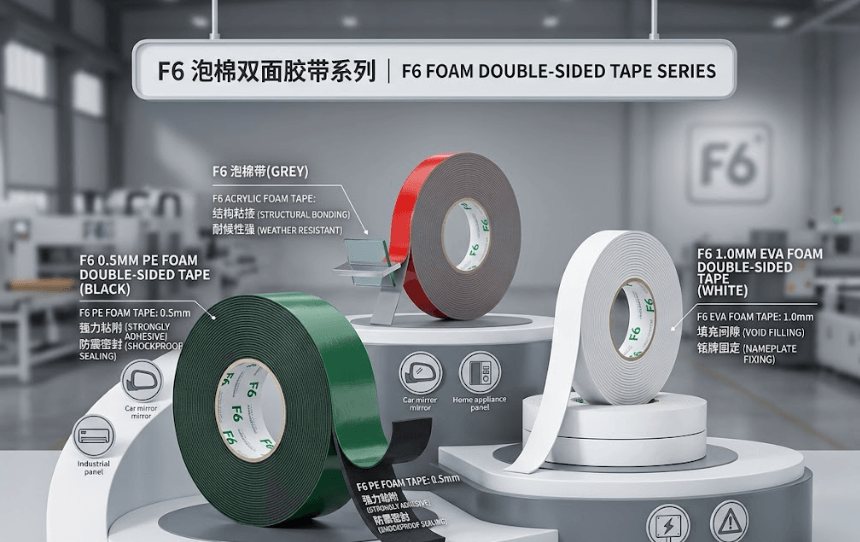
When we partner with OEM project managers, we focus on the “manufacturability” of the adhesive part. A design might look perfect on a CAD drawing, but it must be practical for the converting machinery. Factors such as the “bridge” size between die-cut parts or the choice of release liner can significantly impact the final cost and failure rate.
We recommend evaluating the following technical specs during the design phase:
- Adhesion Levels: Measured in N/25mm (ASTM D3330 standards).
- Temperature Range: Continuous versus peak temperature exposure.
- Liner Type: Paper liners are cost-effective, while film liners are better for cleanroom environments.
- Total Thickness: Crucial for applications with tight mechanical clearances.
By integrating these considerations early, we help our clients avoid the common pitfalls of material fatigue or adhesive migration. Our technical team works closely with procurement to ensure that the chosen custom adhesive tape converting service aligns with both the performance needs and the budget of the project.
Why Choose F6 Tape for Your Converting Needs?
At F6 Tape, we are more than just a material supplier; we are a strategic manufacturing partner. We understand that our customers in the electronics, automotive, and packaging industries require consistency above all else. Our production facility is equipped to handle diverse material types, from BOPP and PET to specialized cloth and foil tapes.
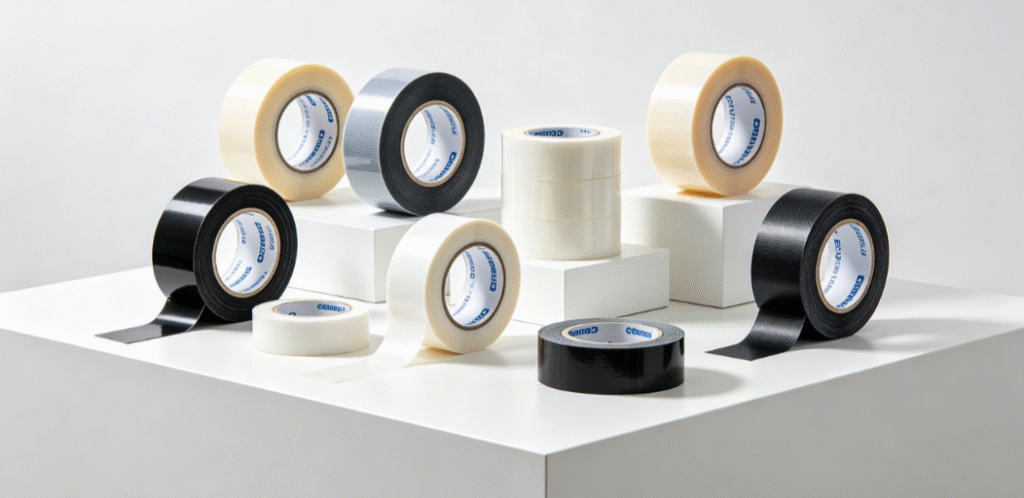
We offer a comprehensive range of products that serve as the “raw stock” for your most demanding applications. By browsing our full product line, you can see the breadth of carriers and adhesives we manufacture. Our expertise in the chemical properties of these tapes allows us to provide guidance on which materials will withstand the rigors of the converting process without losing their integrity.
Whether you need a specific slit width for a packaging line or a complex laminated structure for thermal insulation, our focus is on delivering a solution that integrates seamlessly into your facility. We prioritize quality control at every stage, ensuring that every roll or part meets the rigorous standards of modern industry.
FAQ
Q: What is the typical lead time for custom adhesive tape converting projects?
A: Lead times generally range from 2 to 4 weeks, depending on material availability and the complexity of the die-cutting or laminating requirements.
Q: Can you convert customer-supplied materials, or do you only use your own?
A: While we specialize in converting our own high-performance F6 Tape products, we can evaluate customer-supplied substrates to ensure they are compatible with our machinery.
Q: What are the primary cost drivers in a custom converting order?
A: The main factors include the cost of the base material, the complexity of the tooling (for die-cuts), the total volume, and the labor required for specialized packaging.
Q: Do you provide prototypes or samples before full-scale production?
A: Yes, we provide samples for performance testing to ensure the adhesive and substrate meet your specific application requirements before committing to a large run.
Q: What quality certifications do your manufacturing processes follow?
A: We adhere to strict internal quality management systems, and our products often meet international standards such as ISO 9001, UL, and various ASTM testing protocols.
Reference Sources
- ASTM D3330 – Standard Test Method for Peel Adhesion of Pressure-Sensitive Tape
https://www.astm.org/d3330_d3330m-04r18.html - ISO 9001 Quality Management Systems and Requirements
https://www.iso.org/standard/62085.html