
 Canada
 USA
 Japan



Transfer Double Sided Tape: PET Film Uses & Die Cutting

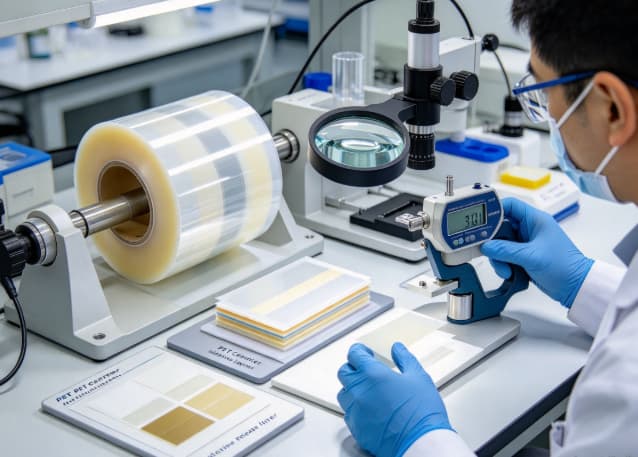
Transfer double sided tape and PET film double sided tape are both used in industrial bonding, but their constructions serve different manufacturing needs. Transfer tape has no permanent carrier, while PET double-sided tape uses a polyester film backing between two adhesive layers.
This distinction matters when selecting materials for industrial PET bonding, precision component mounting, and PET tape die cutting. A carrier-free adhesive may suit applications requiring direct adhesive transfer, whereas a PET-backed construction can provide better dimensional stability during converting and assembly.
For manufacturers, the right choice depends on substrate compatibility, total thickness, adhesive performance, cutting geometry, and production conditions. Understanding these differences helps engineers avoid problems such as adhesive ooze, liner deformation, poor positioning, and edge lifting.
What Is the Difference Between Transfer Tape and PET Film Double Sided Tape?
The main difference is the permanent backing structure.
A transfer double sided tape consists of pressure-sensitive adhesive supported by a removable release liner. Once applied, the liner is removed, leaving only the adhesive layer between the bonded materials.
A double sided PET film tape uses a polyester carrier coated with adhesive on both sides. The PET film remains in the finished assembly and provides structural support during handling and bonding.
| Comparison | Transfer Double Sided Tape | PET Film Double Sided Tape |
|---|---|---|
| Permanent carrier | None | Polyester film |
| Bond construction | Adhesive layer only | Adhesive / PET / adhesive |
| Dimensional stability | Depends on adhesive and liner | Supported by PET carrier |
| Converting | Requires suitable liner support | Suitable for precision die cutting |
| Bond-line structure | Thin, carrier-free | Controlled by film and adhesive thickness |
| Typical applications | Laminating, foam bonding, surface transfer | Electronics, labels, displays, component mounting |
Neither construction is universally better.
Transfer tape is useful when the application requires an adhesive layer without a permanent carrier. PET-backed tape is often more practical when the converted part needs dimensional stability and controlled positioning.
F6 Tape organizes these products separately within its industrial double-sided tape collection, allowing buyers to compare different backing structures.
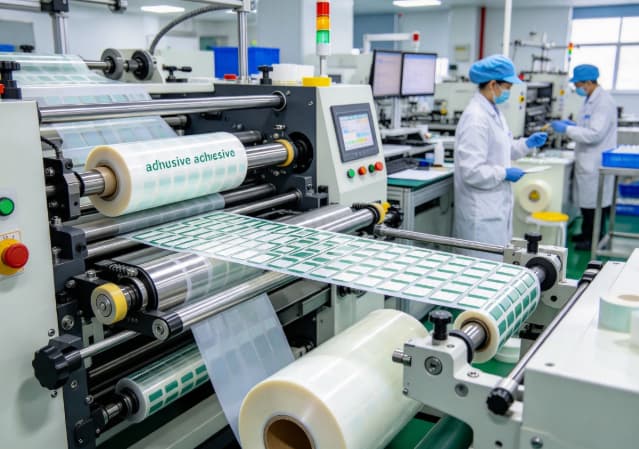
Why Is PET Film Used in Industrial Double-Sided Tape?
PET, or polyethylene terephthalate, is a polyester film widely used as a carrier in adhesive tape manufacturing.
Its dimensional stability and relatively thin profile make it useful for converting applications where the tape must maintain a consistent shape during handling.
The PET carrier contributes several characteristics:
- Dimensional stability: Helps maintain the geometry of narrow strips and die-cut components.
- Handling strength: Supports adhesive layers during converting and application.
- Thin construction: Suitable for assemblies with limited installation space.
- Surface consistency: Provides a relatively uniform backing for adhesive coating.
- Transparency options: Clear PET constructions can support applications where appearance matters.
The carrier does not independently determine the final bond strength. Adhesive chemistry, coating quality, substrate preparation, and application pressure remain important.
For example, a PET-backed tape used on a metal nameplate may require a different adhesive formulation from one applied to a polypropylene housing.
PET Film Tape vs Tissue Double-Sided Tape
PET and tissue carriers are both common in industrial adhesive applications, but their handling characteristics differ.
| Property | PET Film Tape | Tissue Double-Sided Tape |
|---|---|---|
| Carrier | Polyester film | Tissue paper |
| Dimensional stability | Generally higher | More flexible |
| Converting | Suitable for precision shapes | Suitable for general converting |
| Conformability | Depends on film thickness | Often more conformable |
| Typical uses | Electronics, displays, nameplates | General mounting and lamination |
When a converted component requires accurate dimensions, PET may be a more suitable starting point. Tissue tape can be considered when flexibility and conformability are more important.
Industrial Applications of PET Double-Sided Tape
PET film tape is used in applications where thin bonding, accurate positioning, and consistent converted dimensions are important.
1. Electronics and Display Assembly
Electronics manufacturing frequently involves bonding thin components with limited installation space.
PET double-sided tape can be evaluated for:
- LCD and touch display assembly.
- Mobile phone screen components.
- Electronic control panels.
- Internal component mounting.
- Decorative film and protective layer attachment.
Transparent PET constructions can be useful where the adhesive joint should remain visually unobtrusive.
For electronic assemblies, engineers should check insulation requirements, temperature exposure, adhesive migration, and long-term dimensional stability.
2. Industrial Nameplates and Plastic Component Bonding
PET-backed tape is also used to mount identification plates, decorative trims, and plastic components.
Typical bonding combinations include:
- PET film to aluminum.
- Plastic nameplates to metal housings.
- ABS components to painted surfaces.
- Decorative films to plastic panels.
- Industrial labels to equipment enclosures.
The surface finish can influence adhesion considerably. Powder coatings, release agents, textured plastics, and low-surface-energy substrates should be evaluated separately.
3. Automotive and Appliance Components
Automotive and appliance manufacturers use thin adhesive materials for interior components, decorative parts, control panels, and lightweight assemblies.
PET-backed constructions may be considered when the application requires:
- Consistent component dimensions.
- Thin and concealed bonding.
- Accurate die-cut shapes.
- Stable handling during automated assembly.
However, automotive applications may involve thermal cycling, vibration, humidity, and chemical exposure.
A tape that performs well during initial assembly may still require additional aging and environmental testing before production approval.
How Does PET Tape Die Cutting Affect Product Selection?
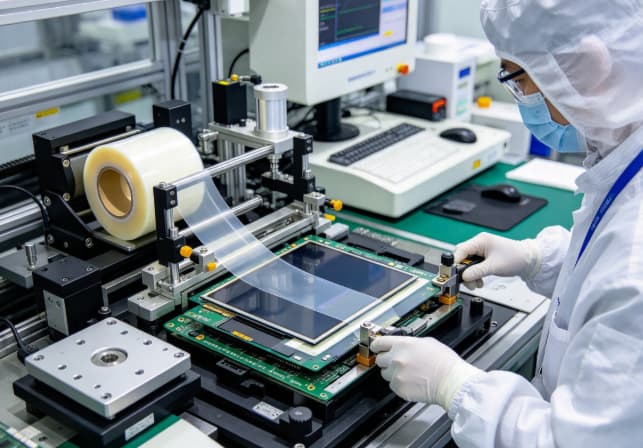
PET tape die cutting is a converting process that uses cutting tools to produce adhesive components in specified shapes and dimensions.
Instead of applying tape directly from a roll, manufacturers can receive pre-cut adhesive parts designed for individual assembly positions.
Common converted formats include:
- Circular adhesive pads.
- Rectangular mounting strips.
- Die-cut electronic component adhesives.
- Custom-shaped nameplate mounting pieces.
- Adhesive strips with extended release liners.
The PET carrier provides support during cutting, stripping, and handling. This can help maintain component geometry, particularly for narrow strips and intricate shapes.
Key Factors in PET Tape Die Cutting
1. Total thickness and tolerance
The total tape thickness includes the PET backing and both adhesive layers. The release liner is normally measured separately.
Thickness variation can affect cutting depth, finished dimensions, and assembly clearance.
2. Release liner selection
The liner must support the tape during converting without creating excessive release force.
If release force is too high, small adhesive parts may lift during liner removal. If it is too low, the tape may move during handling or converting.
3. Adhesive flow and edge performance
Some adhesive formulations can flow under heat or pressure.
This may cause adhesive ooze around cut edges, particularly in small components or applications involving prolonged compression.
4. Cutting geometry
Fine details, small holes, narrow bridges, and sharp corners require suitable tooling and process control.
The converting supplier should evaluate minimum feature dimensions against the tape thickness and adhesive characteristics.
PET Tape Converting Requirements
| Converting factor | What to check | Potential production issue |
|---|---|---|
| Total thickness | PET and adhesive layers | Incorrect cutting depth |
| Release liner | Release force and stiffness | Part lifting or liner deformation |
| Adhesive flow | Edge stability under pressure | Adhesive ooze |
| Die-cut geometry | Minimum feature size | Incomplete cuts |
| Dimensional tolerance | Finished part dimensions | Assembly misalignment |
| Winding quality | Roll tension and alignment | Wrinkles and telescoping |
For high-volume manufacturing, trial converting should use the intended material construction and production tooling wherever practical.
How to Select PET Double-Sided Tape for Industrial Bonding
Selecting a suitable tape requires evaluating the entire bonded assembly rather than relying on a single adhesive performance figure.
The following factors are particularly important.
Adhesive Compatibility With the Substrate
Different materials have different surface characteristics.
Metals, ABS, acrylic, polycarbonate, and polypropylene may require different adhesive formulations.
Low-surface-energy plastics deserve particular attention because standard acrylic adhesives may not achieve sufficient wetting or long-term adhesion.
Thickness and Assembly Clearance
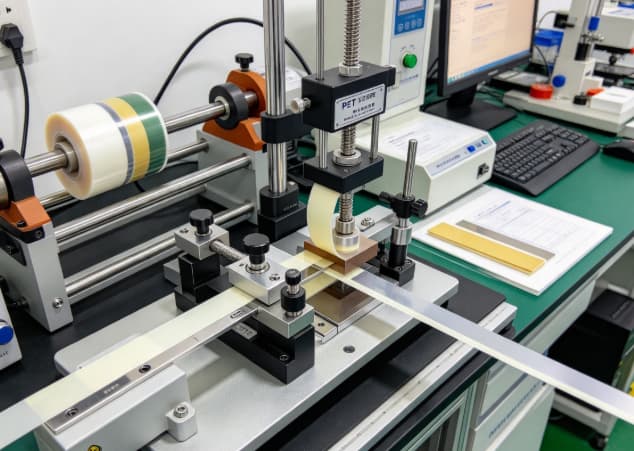
Tape thickness affects component positioning and the finished bond line.
Consider the following:
- PET carrier thickness.
- Adhesive thickness on both sides.
- Release liner thickness during processing.
- Available assembly clearance.
- Surface irregularities.
A thicker construction is not automatically stronger. It must match the component geometry and loading conditions.
Peel Adhesion and Shear Performance
Peel adhesion measures resistance to forces that progressively separate bonded surfaces.
Shear performance evaluates resistance to forces acting parallel to the bonded surfaces.
For industrial PET bonding, both characteristics may matter, particularly when components are mounted vertically or exposed to vibration.
ASTM D3330/D3330M includes test methods for peel adhesion of pressure-sensitive tapes, including double-coated tapes and adhesive transfer tapes.
Testing should use representative production substrates whenever possible. A standard steel-panel result alone cannot establish performance on every plastic or coated surface.
Temperature and Environmental Conditions
Before selecting a product, establish:
- Application temperature.
- Continuous operating temperature.
- Short-term peak temperature.
- Humidity exposure.
- UV and chemical exposure, where relevant.
- Expected service life.
These conditions should be assessed together rather than treating temperature resistance as a single universal rating.
F6 Tape PET Double-Sided Tape Options and Product Selection
F6 Tape offers several PET-backed double-sided tape options within its industrial tape portfolio.
One relevant example is F6965 Transparent PET Double Sided Tape.
According to its published product information, F6965 uses a transparent polyester backing with solvent-based pressure-sensitive adhesive.
Its published specifications include:
| Specification | F6965 |
|---|---|
| Backing material | Transparent polyester |
| Adhesive | Solvent-based PSA |
| Total thickness | 0.205 mm |
| Release liner thickness | 0.075 mm |
| Width | 10–1020/1240 mm |
| Length | 50–500 m |
| Temperature resistance | -20°C to 120°C |
| Long-term temperature resistance | 50°C |
| Short-term temperature resistance | 120°C |
| 180° peel adhesion | 26 N/25 mm |
Specifications are manufacturer-published values. Confirm the current technical data sheet and test conditions before final material approval.
The product page identifies applications including LCD touch displays, mounting on ABS and PP plates, decorative trims, and PVC banners. It also describes support for full and half die-cutting.
For manufacturers considering PET tape die cutting, these features provide a starting point for evaluating material suitability.
However, F6965 is a PET-backed double-sided tape, not a carrier-free transfer tape. The distinction should be maintained when preparing technical specifications or requesting samples.
Buyers can also explore the F6 PET Double-Sided Tape category to compare other available PET constructions.
For a broader comparison of adhesive structures, the Industrial Double-Sided Tape collection includes PET, tissue, transfer, non-woven, PVC, and mesh-fiber options.
4. FAQ
What is the difference between PET double-sided tape and transfer tape?
PET double-sided tape contains a permanent polyester film carrier coated with adhesive on both sides. Transfer tape has no permanent carrier, leaving only the adhesive layer after application.
Is PET film double-sided tape suitable for die cutting?
Yes. PET-backed constructions are commonly considered for precision die-cut adhesive components because the film provides dimensional support during converting.
The final result depends on adhesive flow, liner selection, cutting geometry, and tooling conditions.
Can PET double-sided tape bond metal to plastic?
It can be suitable for certain metal-to-plastic assemblies. However, adhesive compatibility depends on the plastic type, surface coating, texture, and service environment.
Testing on the actual materials is recommended.
What thickness should I choose for industrial PET bonding?
The appropriate thickness depends on assembly clearance, substrate flatness, adhesive requirements, and converting tolerances.
Consider the total construction rather than comparing adhesive thickness alone.
Does PET backing improve tape dimensional stability?
Generally, yes. A PET carrier provides additional support compared with a carrier-free adhesive construction.
This can be beneficial when producing narrow strips, small adhesive components, and precision die-cut parts.
What information is needed when requesting custom PET die-cut tape?
Provide the following information:
- Substrate materials and bonding surfaces.
- Required tape thickness.
- Component drawings or dimensions.
- Die-cut shape and tolerances.
- Roll or sheet delivery preference.
- Expected operating temperature.
- Estimated production quantity.
These details help determine whether an existing PET tape construction can meet the application requirements.