
 Canada
 USA
 Japan



Transfer Double Sided Tape: Specs That Decide Bond Success

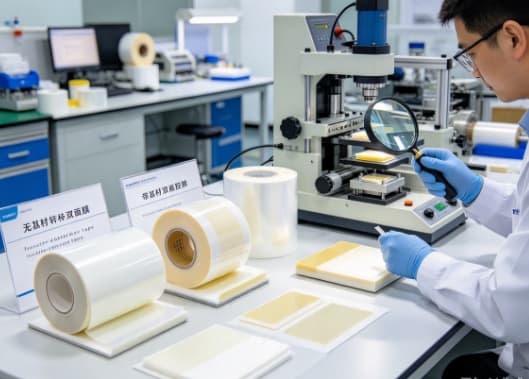
Transfer double sided tape is an adhesive film with no carrier, supplied on a release liner. Strip the liner and what remains is pure pressure-sensitive adhesive, often only 50 to 150 µm thick. That single structural detail explains both its advantages and most of its field failures.
Buyers usually meet this product through a laminating or bonding problem, not a catalogue. This guide covers what the construction is, how thickness and chemistry interact, and which specifications belong on a purchase order.
What Transfer Double Sided Tape Actually Is
An adhesive transfer tape carries adhesive on both faces with nothing in between. Converters also call it unsupported double-coated tape, glue film, or transfer adhesive. Because no tissue, PET or foam sits in the middle, the bond line equals the adhesive thickness.
That changes how the joint behaves. A carrier spreads stress and limits compression; without one, the adhesive alone resists shear and creeps under load. Peel figures alone rarely predict that behaviour.
| Format | Middle layer | Typical bond line | Characteristic failure |
| Adhesive transfer tape | None — adhesive only | 0.03–0.30 mm | Creep or edge ooze under load |
| Tissue double-sided | Nonwoven tissue | 0.08–0.16 mm | Tearing on rough or flexing parts |
| PET film double-sided | PET film | 0.05–0.15 mm | Lifting on curved surfaces |
| Fiberglass mesh | Woven mesh | 0.15–0.30 mm | Texture read-through on thin faces |
| Foam double-sided | PE, PU or EPDM foam | 0.4–2.0 mm | Compression set, thick gap |
These are typical ranges rather than universal ones, so confirm them against the supplier data sheet. Where a joint needs a carrier, thetissue and mesh side of the industrial double sided tape range covers most converting work.
What the adhesive itself is made of
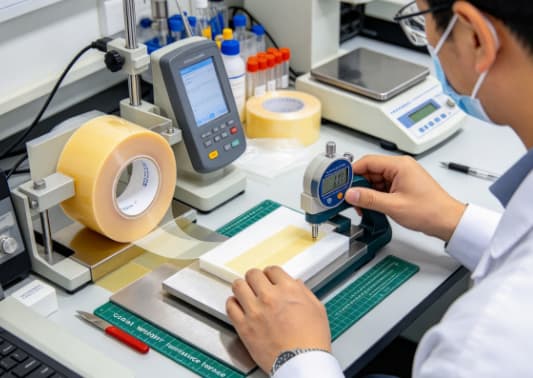
Acrylic is the default for industrial transfer constructions. Solvent acrylic offers the widest temperature and ageing window. Water-based grades cut VOC and odour, which matters for interiors, appliance parts and enclosed assemblies.
Rubber adhesives grab faster and bond low-energy plastics at lower cost. Their temperature ceiling and UV resistance are weaker, so outdoor exposure needs caution. Silicone exists for one purpose: bonding to silicone and other release surfaces.
Grade selection comes down to chemistry plus tack level. A standard acrylic suits clean metal and painted panels. Rough or low-energy surfaces need a high-tack build, such as ultra-viscosity tissue tape or low VOC low odour tape for odour-sensitive work.
Surface energy sets the practical limit
Metals and glass sit above 40 dyn/cm, ABS and PC around 38–42, PP and PE near 30. Below roughly 34 dyn/cm a standard acrylic will not wet out properly. At that point you need a high-tack formulation, a primer, or corona treatment — tested on the real part, not a steel panel.
Transfer Tape Thickness: Reading the Numbers Correctly
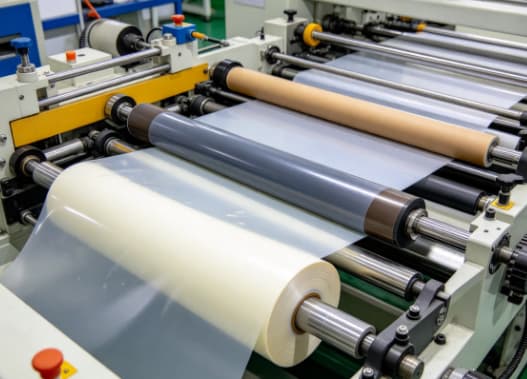
On a transfer tape, thickness is not a fixed property. It is coat weight divided by adhesive density. A 100 g/m² acrylic coat lands near 0.10 mm, while a softer rubber adhesive at the same weight runs slightly thicker.
Ask for both figures. A micron value on its own hides how much adhesive is actually in the roll.
| Nominal thickness | Coat weight guide | Usual job | Risk to watch |
| 0.03–0.05 mm | 30–50 g/m² | Overlamination, membrane switch spacers | Trapped air on wide webs |
| 0.05–0.10 mm | 50–100 g/m² | Nameplates, film-to-board lamination | Creep on vertical or loaded parts |
| 0.10–0.20 mm | 100–200 g/m² | Textured or slightly uneven surfaces | Edge ooze at elevated temperature |
| 0.20–0.30 mm | 200–300 g/m² | Foam, felt and fabric bonding | Softness cuts shear resistance |
Thicker is not stronger. Extra adhesive buys conformability and peel, but it also adds mass that flows under load. For a vertical joint carrying weight, a thin high-cohesion film usually beats a thick soft one.
Tolerance deserves equal attention. Most suppliers hold total thickness within about ±10%, and width within roughly ±1 mm after slitting. On a 0.05 mm product, 10% variation is 5 µm — enough to shift stack height in a thin display module.
Applications Where Carrier-Free Adhesive Wins
Six situations reward the missing carrier:
- Film and foil lamination. A carrier edge can telegraph through thin face stock; adhesive alone cannot.
- Membrane switches and electronics. Thin bond lines keep stack height predictable and die-cutting clean, which suits appliance and electronics assembly.
- Nameplates and overlays. The part sits nearly flush with the panel, with no visible step.
- Web splicing. Thin tape passes through rollers and past doctor blades without a bump.
- Foam-to-plastic bonding. Here the foam core usually earns its thickness, so foam double sided tape is the better starting point.
- Wide-format print mounting. Thin adhesive avoids the ripple a stiff carrier creates on print and display work.
Transfer Tape for Laminating: Three Process Conditions That Cause Failure
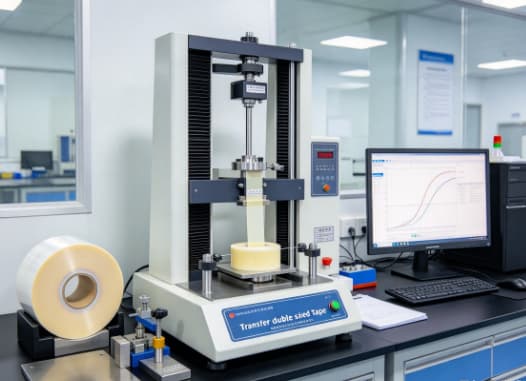
Most laminating complaints trace back to the nip, not the adhesive.
- Nip load and dwell. Low pressure leaves micro-bubbles that grow once the part sees heat. Check roller hardness and crown before blaming the tape.
- Liner release at line speed. A tight liner that peels cleanly by hand can drag adhesive at 30 m/min.
- Surface condition. Dust, mould-release agent and plasticiser migration all attack the bond interface.
Wide webs trap air more readily than narrow strips. Slowing the line or adding a second nip usually works better than switching to a thicker product.
Heat after lamination is a separate risk. Softening adhesive flows at the edge, and the joint then fails from the perimeter inward. Judge the continuous service temperature, never the short-term peak alone.
Worth knowing: sampling delays often appear here rather than at quotation. A converter cannot predict laminating behaviour from a data sheet. A trial roll on production equipment is usually the fastest route to a decision.Contact F6 Tapes for a sample roll and a quotation based on your application spec.
Specifying Transfer Double Sided Tape on a Purchase Order
A quote is only as good as the specification behind it. Entries such as “strong double sided tape, 0.1 mm” leave chemistry, liner and coat weight undefined.
Write these fields instead:
- Construction and total thickness, with tolerance
- Coat weight in g/m²
- Adhesive chemistry and solids type
- Liner material, colour and release level
- Roll width, length and core diameter
- Die-cut format, if applicable
- Continuous and peak service temperature
- Compliance: RoHS, REACH, halogen-free, flame retardancy
- Test method and acceptance value
- Shelf life and storage condition
The test method line matters more than most buyers expect. ASTM D3330 Method C covers double-coated tape with a carrier. Adhesive transfer tape falls under Method E, while ISO 29862 Method 3 addresses both formats.
A data sheet quoting Method C for a carrier-free product is not measuring the same joint. Ask for method, dwell time and failure mode together. Without all three, a peel value cannot be compared across suppliers.
The peel adhesion test explained here shows how far the reported figure moves with test conditions.
Where a standard width or liner does not fit the line, custom converting is often cheaper than redesigning the process around a stock roll.
FAQ
Is transfer tape the same as double-sided tape? Not quite. Double-sided tape usually has a carrier — tissue, PET, mesh or foam — between two adhesive layers. Transfer tape is adhesive only, so the bond line is thinner and more conformable.
What thickness should I choose for laminating? Start at 0.05 mm for smooth film-to-board work. Move to 0.10–0.20 mm only when the surface is textured or the parts are slightly uneven.
Why does transfer tape slide under load? Because no carrier shares the stress. Adhesive alone resists shear, so sustained loads cause creep, especially above 40 °C or on vertical joints.
Which test standard applies to transfer tape? ASTM D3330 Method E and ISO 29862 Method 3 both cover transfer and double-sided formats. Method C applies to carrier-based double-coated tape.
Can transfer tape bond PP or PE? Sometimes, but not with a standard acrylic. Specify a high-tack grade or add a primer, then verify on production parts rather than test panels.
Does a thicker transfer tape hold more weight? Usually no. Thicker adhesive improves wet-out and peel, but reduces shear resistance because the adhesive layer deforms more easily.
Reference Source
- ISO 29862:2024 — Self adhesive tapes — Determination of peel adhesion properties — Method 3 covers double-sided and transfer tapes.
- ASTM D3330/D3330M — Standard Test Method for Peel Adhesion of Pressure-Sensitive Tape — Method E covers adhesive transfer tape.
- 3M — Common Chemistry of PSA Tapes— Acrylic, rubber and silicone performance trade-offs.
- F6 Tapes — Peel Adhesion Test for Pressure Sensitive Tape — ASTM D3330 and ISO 29862 test conditions.
- F6 Tapes — Temperature Resistant Adhesive Tape Selection for Industrial Use — Continuous versus short-term exposure.
- F6 Tapes — Tissue Double-sided Tape product range — Carrier-based alternative constructions.